
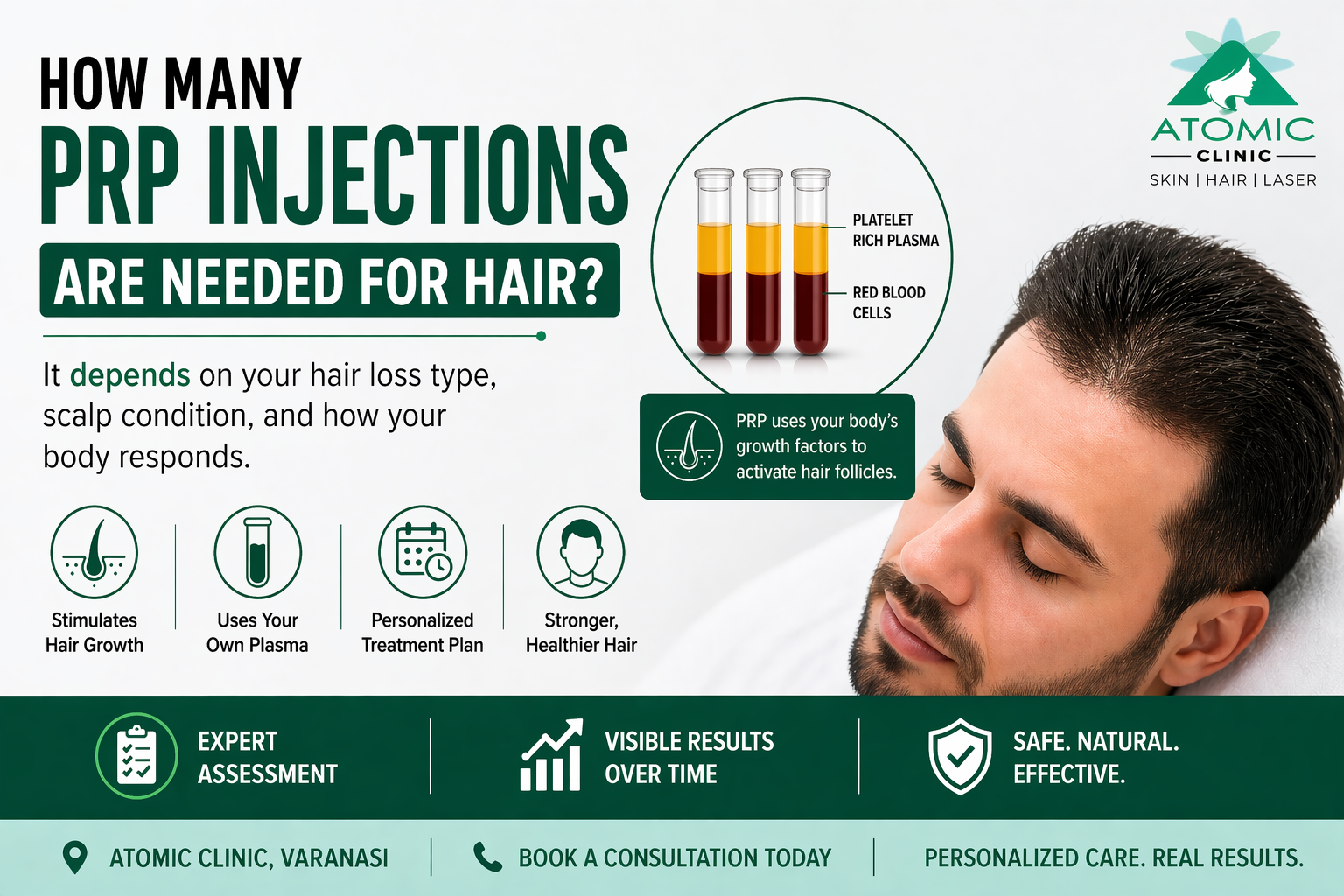
How Many PRP Injections Are Needed for Hair?

If you have been researching PRP therapy for hair loss, this question has probably come up more than once. How many sessions will it take? How often do you need them? Will it actually work for your specific type of hair loss? These are fair questions, and the honest answer is that it depends — not on a standard protocol, but on what is actually happening with your hair and scalp. If you are asking how many PRP injections are needed for hair regrowth, recurring hair thinning, or pattern baldness, this article will give you a realistic picture based on clinical experience, not a number pulled from a general guideline.
First, What PRP Actually Does
PRP stands for Platelet-Rich Plasma. It is derived from your own blood. A small amount is drawn, processed in a centrifuge to concentrate the platelets, and then injected into areas of the scalp where hair thinning or loss is occurring.
Platelets carry growth factors — proteins that signal the body to repair tissue and stimulate cell activity. In the context of hair, these growth factors work on the hair follicles directly, encouraging dormant or weakened follicles to re-enter an active growth phase. PRP does not create new follicles. What it does is work with what is already there — reviving follicles that have not yet died but have become inactive or weak.
This distinction matters when it comes to how many sessions you will need, because the condition of your follicles at the time of treatment directly affects the outcome.
There Is No Universal Number
This is the part most people do not want to hear, but it is the most accurate answer available.
You will find articles online that say three sessions, or six sessions, or one session every month for a year. Some of those numbers come from research studies done on specific patient populations under controlled conditions. They are useful as a starting point, but they are not a prescription for every individual.
The number of PRP injections needed for hair depends on several factors that vary from person to person.
What Determines How Many Sessions You Need
Stage of hair loss is the most significant factor. Early-stage hair thinning responds faster and often requires fewer sessions to see visible improvement. Advanced hair loss — where follicles have been inactive for a longer period — typically requires more sessions, and the results may be more gradual. In cases where hair loss is very advanced and follicles are no longer viable, PRP has limited effectiveness regardless of the number of sessions.
The cause of your hair loss changes the approach entirely. Androgenetic alopecia — the most common form, also called male or female pattern baldness — responds differently to PRP than alopecia areata, telogen effluvium caused by stress or nutritional deficiency, or hair loss secondary to a hormonal condition like thyroid dysfunction or PCOS. Treating the wrong type of hair loss with a standard PRP schedule produces disappointing results.
Your platelet count and quality also play a role. Since PRP is made from your own blood, the concentration and activity of your platelets directly affect how potent your treatment is. Some individuals naturally have higher platelet counts, which means their PRP is richer in growth factors. This is something that can be assessed before treatment begins.
How your scalp responds after the first few sessions is equally important. A good clinician adjusts the protocol based on what they observe — not just follows a fixed schedule regardless of individual progress.
A General Clinical Framework
Without examining a patient individually, here is how PRP hair treatment is typically structured in a clinical setting:
The initial phase usually involves sessions spaced three to four weeks apart. Most patients go through three to four sessions in this phase. This is the period where the follicles are being stimulated most intensively, and it is also when the first signs of response begin to appear — usually reduced shedding before new growth becomes visible.
After the initial phase, sessions become less frequent. A maintenance session every three to six months is common for patients who have responded well. This is not optional — hair follicles need ongoing support because the underlying cause of hair loss does not disappear after a course of PRP. Without maintenance, the results gradually diminish.
Some patients require a longer initial phase. Others maintain results well with fewer sessions. This is precisely why a clinical assessment before starting treatment is not a formality — it is the only way to build a plan that is actually appropriate for your scalp.
What Realistic Results Look Like
PRP is not a dramatic overnight transformation. Patients who go in expecting thick hair after two sessions will be disappointed. What most people experience after a proper course of treatment is a reduction in shedding first, followed by gradual improvement in hair density and thickness over several months.
Photographs taken before treatment and at regular intervals are the most reliable way to track progress, because day-to-day changes are subtle enough to miss without comparison.
Results also depend on whether any contributing factors — nutritional deficiencies, hormonal imbalances, stress — are being addressed alongside PRP. The injections support follicle activity, but they cannot override a body that is nutritionally depleted or hormonally disrupted.
What to Ask Before You Start
Before committing to a PRP hair treatment plan, a few things are worth clarifying with your treating doctor. What type of hair loss do I have, and is PRP appropriate for it? What does my scalp assessment show about follicle viability? How many sessions are you recommending for my specific case and why? What results should I realistically expect and over what timeframe?
These are not difficult questions, and any clinic offering PRP should be able to answer them clearly. If the answer to all of them is a generic package with a fixed number of sessions regardless of your individual condition, that is worth reconsidering.
Get the Right Answers for Your Scalp
PRP for hair loss is a treatment that works — when it is the right treatment for the right patient, administered correctly, and followed through consistently. The number of sessions that will work for you is not something any article can tell you with precision, because it depends on your scalp, your hair loss pattern, your blood, and your body’s response.
At Atomic Clinic in Varanasi, we assess each patient individually before recommending any treatment plan. If you are considering PRP for hair loss and want to understand what it would actually involve for your specific condition — how many sessions, what to expect, and whether it is the right approach at all — we can give you that clarity. A consultation is the starting point, not a sales pitch.
Reach out to Atomic Clinic and get the information that is specific to you, not a number from a general guideline.