
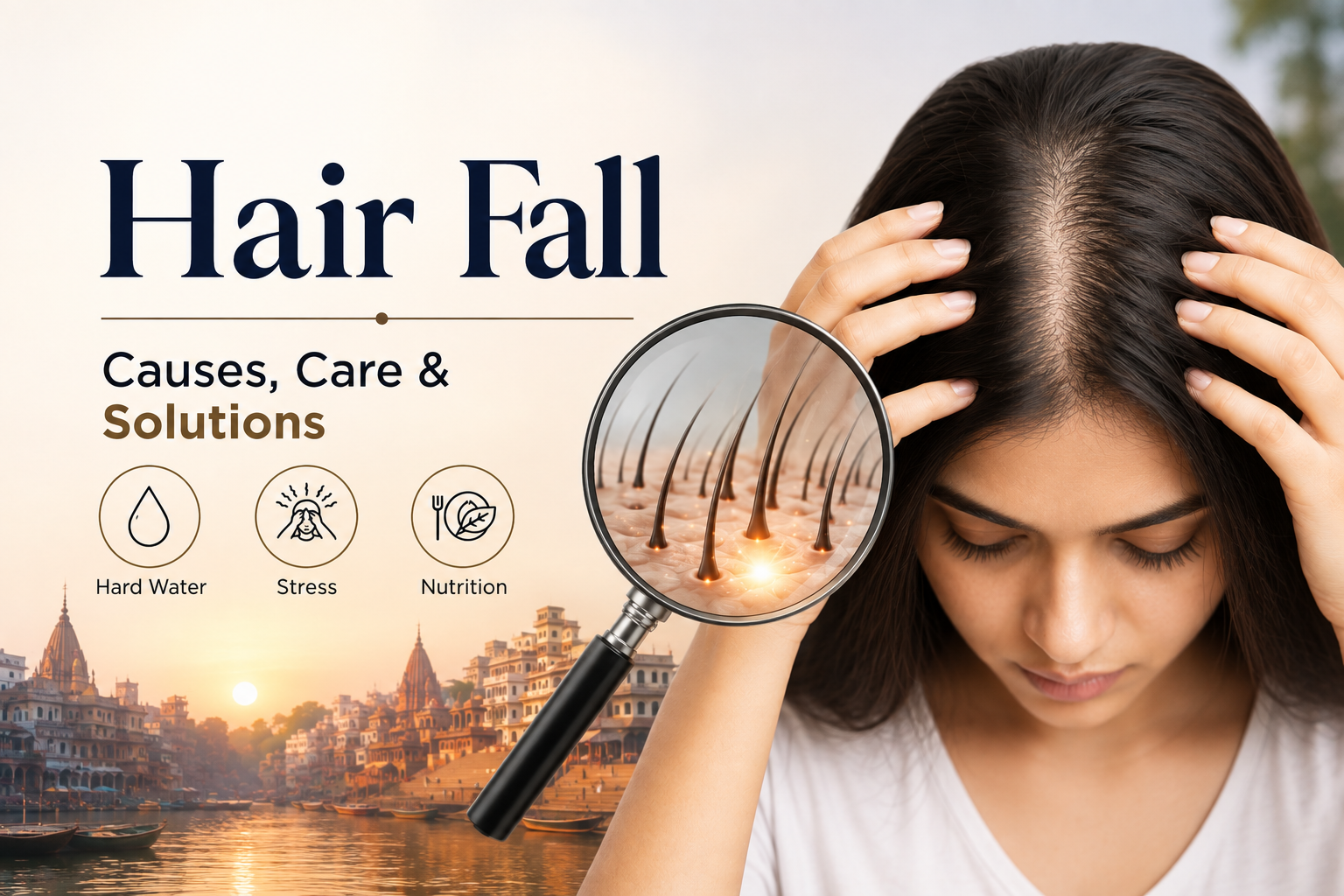
Hair Fall in Varanasi — Is It the Water, the Heat, or Something Else?

A lot of people who visit our clinic say something similar before we even begin the consultation:
“Doctor, I’ve tried everything. Oils, shampoos, home remedies… but my hair fall isn’t stopping.”
I understand why they feel frustrated. Hair fall can be surprisingly difficult to figure out because it doesn’t always have one clear cause. Stress, diet, genetics, hormonal changes, scalp conditions, nutritional deficiencies, illness and even everyday hair-care habits can all play a role.
And that’s why changing shampoos every few weeks or trying one home remedy after another often doesn’t solve the real problem.
If you live in Varanasi, there are a few additional factors worth considering.
Could Varanasi’s Water Be Affecting Your Hair?
This is probably one of the first questions people ask me:
“Is the water here causing my hair fall?”
Hard water can certainly affect the condition of your hair, but it’s important to understand what it can and cannot do.
Hard water contains higher levels of minerals such as calcium and magnesium. Regular exposure can leave mineral deposits on the hair, making it feel rough, dry or difficult to manage. Over time, this may contribute to hair damage and breakage.
That is different from hair shedding from the root.
If you’re seeing broken, shorter strands, your problem may be hair-shaft damage. If you’re noticing more complete strands coming out from the scalp, particularly along with thinning, the underlying cause may be different.
This distinction matters because breakage and excessive shedding aren’t treated in the same way.
If your hair fall has continued for several months, it’s better to have the scalp and hair properly evaluated rather than assuming the water is the only reason.
Varanasi’s Heat Can Make Scalp Problems More Noticeable
The summer heat can be hard on both your scalp and your hair.
When you sweat more, your scalp can become oilier and uncomfortable. People who already have dandruff or seborrhoeic dermatitis may notice more itching, scaling or flaking during hot weather.
Frequent sweating doesn’t automatically mean you’ll lose your hair, but an irritated or inflamed scalp can make existing scalp problems harder to manage.
There’s another practical issue too: people often wash their hair more frequently during summer, use stronger cleansing products, or rely heavily on heat styling and blow-drying. When these habits are combined with sun and environmental exposure, the hair shaft can become dry and brittle.
So if your hair feels noticeably rougher or breaks more easily during the summer, your hair-care routine deserves a closer look.
Stress and Diet Are Often Overlooked
One of the most important things I discuss with patients is what happened in the few months before their hair fall became noticeable.
A period of significant stress, a high fever or illness, rapid weight loss, major dietary restriction or certain nutritional deficiencies can sometimes trigger a type of shedding called telogen effluvium.
What makes it confusing is the timing.
The hair fall may not start immediately after the stressful event or illness. It can become noticeable several weeks to a few months later. By then, many people have forgotten about the event that may have triggered it.
Diet matters too.
Hair growth requires adequate protein and a range of nutrients. Very restrictive diets, inadequate protein intake and certain deficiencies can contribute to increased shedding.
Iron deficiency is particularly important to consider in people who are at risk of it. But supplements shouldn’t be taken blindly. If a deficiency is suspected, appropriate blood tests can help determine whether supplementation is actually needed.
How Much Hair Loss Is Normal?
Some daily shedding is normal. Hair naturally moves through different phases of growth, resting and shedding, so seeing a few hairs on your pillow or in the shower isn’t necessarily a sign of a disease.
What matters more is a change from your usual pattern.
You should consider seeing a dermatologist if:
Your hair is noticeably thinner than it used to be.
Your parting appears wider or your hairline is changing.
You are developing visible patches of hair loss.
You are losing considerably more hair than usual for several weeks.
Hair fall continues for months without improvement.
You have scalp itching, redness, scaling or other persistent symptoms along with hair loss.
Early evaluation can be useful because different types of hair loss require different approaches.
What Treatment Is Right for Hair Fall?
There isn’t one treatment that works for every type of hair loss.
The first step should be identifying what is causing the shedding or thinning.
For some people, correcting a nutritional deficiency or treating an underlying scalp condition may be enough to improve the situation. Others may have pattern hair loss, in which case treatments such as minoxidil may be considered depending on the individual.
PRP Therapy
Platelet-rich plasma, commonly called PRP, is used in some cases of hair loss, particularly certain forms of pattern hair loss.
The procedure uses a small sample of the patient’s own blood. The platelet-rich portion is separated and then administered into areas of the scalp being treated.
PRP may help improve hair density and reduce shedding in appropriately selected patients, but results aren’t identical for everyone. The number of sessions and the interval between them should be decided after assessing the type and severity of hair loss.
GFC Treatment
Growth Factor Concentrate (GFC) is another injectable treatment used in some hair-loss cases. It focuses on delivering concentrated growth-factor components to the scalp.
As with PRP, it shouldn’t be presented as a universal solution for hair loss. Whether it is appropriate depends on the underlying condition, the degree of thinning and the patient’s individual circumstances.
Mesotherapy
Mesotherapy involves delivering selected substances through small injections into the scalp. Different clinics may use different formulations, so patients should ask exactly what is being used and why it has been recommended.
It is particularly important not to assume that vitamin injections will correct hair loss if there is no confirmed deficiency.
Medicines for Pattern Hair Loss
For androgenetic alopecia, commonly known as pattern hair loss, medicines such as minoxidil may be recommended after a proper assessment.
Finasteride may also be considered for some men with male-pattern hair loss, but it isn’t appropriate for everyone and requires discussion with a qualified doctor because of its potential side effects and precautions.
These medicines shouldn’t be started simply because someone else has used them successfully.
What Can You Do at Home?
There are a few simple things you can do while you’re figuring out what’s behind your hair fall.
Take a closer look at your water.
If you live in an area with hard water and your hair has become dry, rough or prone to breakage, filtered water for the final rinse or hair washing may be worth trying.
Eat enough protein.
Include foods such as eggs, dal, paneer, dairy products, fish, chicken, soy, sprouts or other suitable protein sources according to your diet.
Avoid crash diets.
Rapid weight loss and severe calorie restriction can trigger excessive shedding.
Reduce unnecessary heat and chemical treatments.
Frequent straightening, curling, high-heat blow-drying and repeated chemical treatments can weaken the hair shaft.
Be gentle with wet hair.
Avoid aggressive towel rubbing and harsh combing. Tight hairstyles can also contribute to hair breakage and, when worn repeatedly, traction-related hair loss.
Don’t start supplements without a reason.
Biotin, iron, vitamin D and other supplements are often marketed as solutions for hair fall. They can be useful when a deficiency exists, but taking them unnecessarily isn’t a substitute for finding the actual cause.
When Should You See a Dermatologist?
If your hair fall has been going on for a few weeks, it’s natural to hope it will settle on its own.
Sometimes it does.
But persistent shedding, visible thinning or patchy hair loss deserves an assessment. The earlier the cause is identified, the easier it may be to manage the condition and prevent unnecessary progression.
At Atomic Clinic, we begin by looking at the pattern of hair loss, scalp condition, medical history, diet, recent illnesses, medications and other relevant factors. Blood tests may be suggested when the history or examination indicates that they could be useful.
Treatment is then planned according to the cause rather than simply choosing a procedure because it is currently popular.
That distinction is important.
Hair fall isn’t one condition, and there isn’t one treatment for everyone.
If you’ve been struggling with hair fall and aren’t sure what’s causing it, you can book a consultation with our team. Atomic Clinic has centres in Sunderpur and Varuna, Varanasi.
You can also contact us at +91-7310101562 to discuss an appointment.
Dr. Sneha Gupta is a skin and aesthetic expert at Atomic Clinic, Varanasi. The information above is intended for general education and does not replace an individual medical consultation.