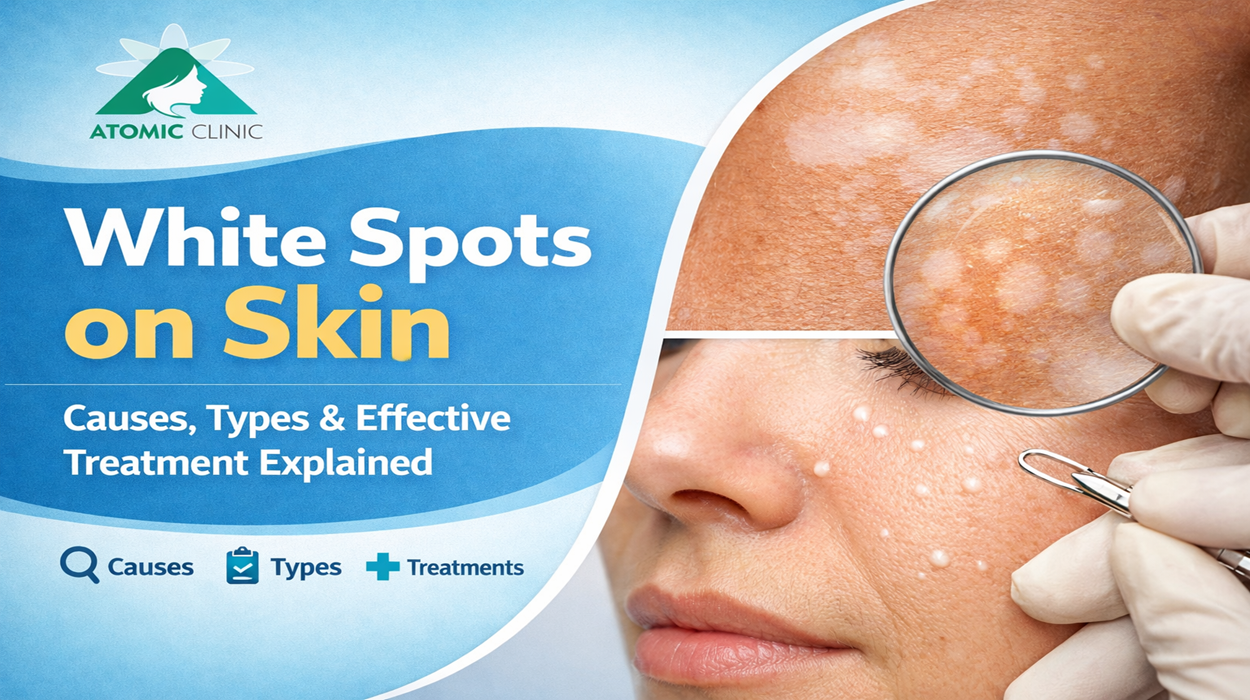
White Spots on Skin: Causes, Types & Effective Treatment Explained

Noticing white spots on your skin can be confusing—and sometimes worrying. They may appear suddenly, spread slowly, or stay unchanged for months. Many people assume it’s a minor issue, while others fear it could be something serious.
At Atomic Clinic, we often meet patients who are unsure whether these white patches are due to sun damage, a skin condition, or something else entirely. The truth is, white spots on skin can have multiple causes, and identifying the exact reason is the first step toward the right treatment.
Let’s understand this in a simple, practical way.
What Are White Spots on Skin?
White spots are areas of skin that appear lighter than your natural skin tone. This happens when there is a reduction or loss of melanin, the pigment responsible for giving your skin its color.
These spots can vary in:
- Size (tiny dots to large patches)
- Shape (round, irregular, or spreading)
- Texture (smooth, dry, or slightly scaly)
Some are completely harmless, while others may need medical attention. That’s why it’s important not to ignore them.
Common Causes of White Spots on Skin
White spots are not a single condition—they are a symptom of different underlying issues. Here are the most common causes we see in clinical practice:
1. Milia (Tiny White Bumps)
Milia are small, pearl-like white bumps that often appear around the eyes, cheeks, or nose. They are caused by keratin getting trapped under the skin.
- Common in both adults and newborns
- Not painful or itchy
- Do not go away with regular acne treatments
Many people try to squeeze them, which can lead to marks or irritation. Professional removal is the safest option.
2. Pityriasis Alba (Common in Children & Teens)
This condition shows up as light, slightly dry patches, usually on the face.
- Often linked to dry skin or mild eczema
- More visible in people with darker skin tones
- Becomes more noticeable after sun exposure
It’s harmless and usually fades with proper moisturization and sun protection.
3. Fungal Infection (Tinea Versicolor)
One of the most common reasons for white spots on the body is a fungal infection known as tinea versicolor.
- Appears on chest, back, neck, or arms
- May cause mild itching
- Spots can be white, pink, or light brown
This happens due to an overgrowth of yeast on the skin. It is treatable with antifungal medications.
4. Vitiligo (Pigment Loss Condition)
Vitiligo is a condition where the skin loses pigment in certain areas due to an autoimmune response.
- White patches are clearly defined
- Can spread over time
- May affect face, hands, elbows, or knees
While it is not harmful or contagious, it does require proper medical evaluation and long-term management.
5. Sun Damage (Idiopathic Guttate Hypomelanosis)
Small white spots can also develop due to long-term sun exposure, especially in adults.
- Common on arms and legs
- More visible with age
- Not itchy or painful
This is usually a cosmetic concern but indicates the need for better sun protection.
How to Identify the Type of White Spots
Since different conditions look similar, self-diagnosis can be misleading. Here are a few simple ways to observe your skin:
- Are the spots dry or flaky? → Could be fungal infection or pityriasis alba
- Are they tiny, raised bumps? → Likely milia
- Are they spreading or sharply defined? → May need evaluation for vitiligo
- Do they itch? → Often linked to fungal causes
If you’re unsure, it’s always better to get a professional opinion instead of experimenting with treatments.
When Should You Be Concerned?
White spots are not always serious, but you should consider visiting a skin clinic if:
- The spots are increasing in number
- They are spreading to new areas
- You notice complete loss of skin color in patches
- Over-the-counter creams are not helping
- The condition is affecting your confidence
Early diagnosis not only helps in faster treatment but also prevents unnecessary complications.
Effective Treatments for White Spots on Skin
Treatment depends entirely on the cause. At Atomic Clinic, we focus on targeted, safe, and result-oriented treatments rather than one-size-fits-all solutions.
1. Medical Creams & Topical Treatments
For mild conditions, dermatologists may recommend:
- Antifungal creams (for fungal infections)
- Mild steroids or soothing creams (for dry patches)
- Retinoids (for milia prevention)
These help restore skin balance over time.
2. Professional Extraction (For Milia)
If the white spots are due to milia, they can be safely removed using sterile tools by trained professionals.
- Quick procedure
- Minimal discomfort
- Immediate visible results
3. Chemical Peels
Chemical peels help in:
- Removing dead skin buildup
- Improving skin texture
- Reducing appearance of spots
They are especially helpful for uneven skin tone and mild pigmentation issues.
4. Laser & Advanced Treatments
For conditions like vitiligo or stubborn pigmentation, advanced dermatological treatments may be advised.
These are planned carefully based on:
- Skin type
- Severity
- Area affected
What You Should Avoid
Many people unknowingly worsen their skin condition by trying random solutions. Avoid:
- ❌ Using steroid creams without prescription
- ❌ Scrubbing aggressively
- ❌ Trying DIY remedies from social media
- ❌ Ignoring sun protection
- ❌ Picking or scratching the spots
These can lead to irritation, burns, or permanent marks.
How to Prevent White Spots on Skin
While not all conditions can be prevented, you can reduce your risk by following a simple skincare routine:
- Use a gentle cleanser suitable for your skin type
- Keep your skin well-moisturized
- Apply broad-spectrum sunscreen daily
- Avoid sharing towels or personal items (to prevent fungal infections)
- Maintain good hygiene, especially in humid weather
Consistency matters more than using too many products.
Expert Advice from Atomic Clinic
From our experience, one of the biggest mistakes people make is treating all white spots the same way. What works for a fungal infection won’t work for milia, and what helps dry patches won’t help pigment loss.
That’s why a proper skin assessment is important. It saves time, avoids wrong treatments, and helps you see better results faster.
Final Thoughts
White spots on skin may seem like a small issue, but they can have different underlying causes. Some are temporary and harmless, while others may need proper medical care.
The key is not to panic—but also not to ignore.
With the right understanding and expert guidance, most white spots can be managed effectively, helping you regain clear and healthy-looking skin.
Book Your Consultation at Atomic Clinic
If you’re dealing with white spots and unsure about the cause, it’s best to get it checked early.
At Atomic Clinic, we offer:
✔ Personalized skin diagnosis
✔ Safe and effective treatments
✔ Guidance tailored to your skin type
Book your consultation today and take the first step towards clearer, healthier skin.