
Microneedling for Acne Scars: What It Can and Cannot Do

Acne may disappear, but the marks it leaves behind can stay for much longer.
For some people, the problem is mainly discoloration. For others, the skin surface becomes uneven, with small depressions that become more noticeable under certain lighting. These are acne scars, and they can be surprisingly difficult to treat with creams alone.
Microneedling is one of the treatments used to improve the appearance of certain acne scars. It has become popular because it works with the skin’s natural repair process rather than simply covering the uneven texture.
But there’s an important point that often gets missed: microneedling isn’t suitable for every type of acne scar, and it doesn’t completely erase scars.
Understanding what the treatment can realistically achieve is the first step toward deciding whether it’s right for your skin.
What is microneedling?
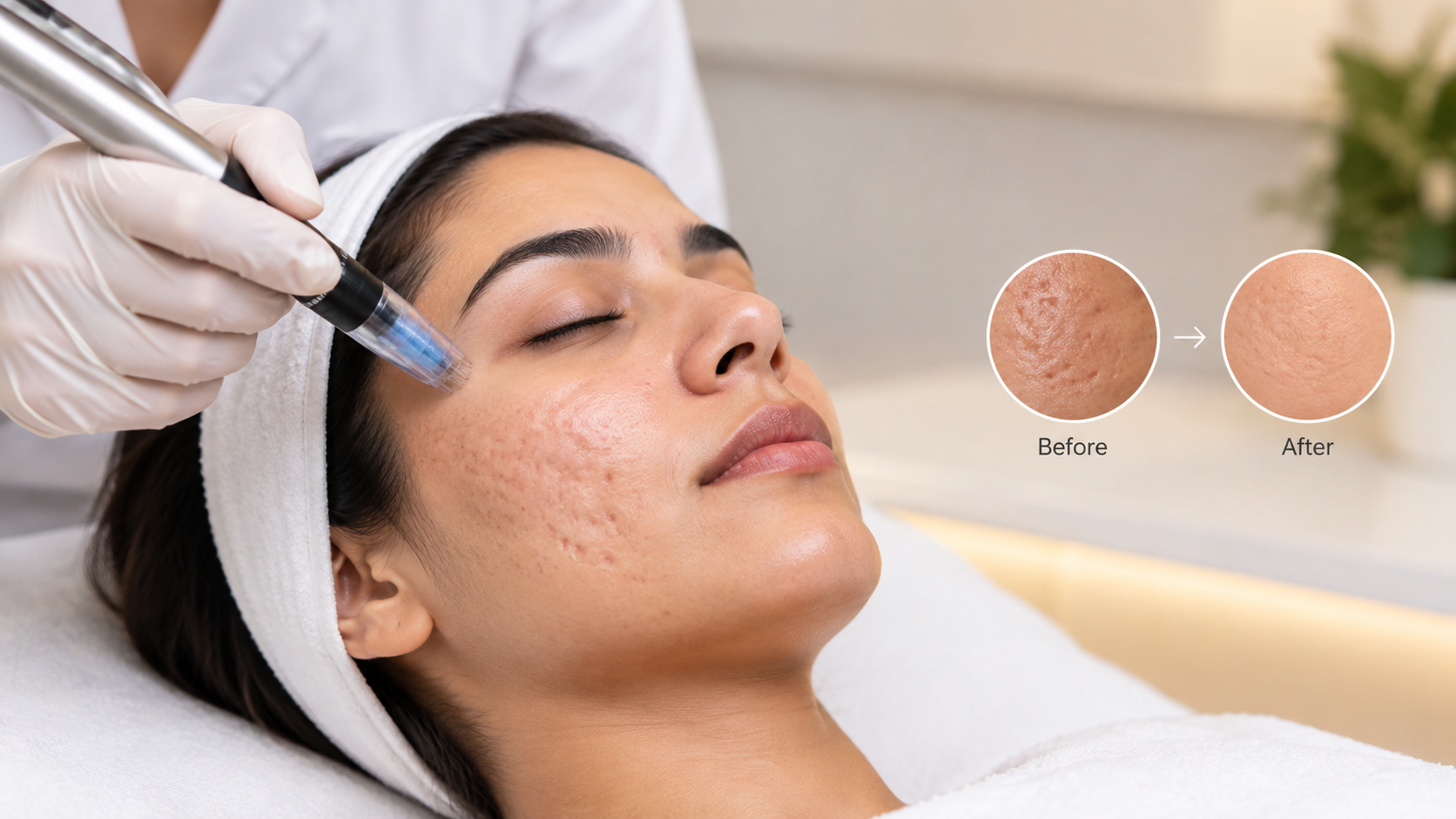
Microneedling is a skin treatment in which very fine needles create controlled micro-injuries in the skin.
That may sound alarming, but the purpose isn’t to damage the skin unnecessarily. The controlled stimulation encourages the skin’s repair response. As the skin heals, collagen and other supporting components are produced as part of that process.
Over time, this can help improve the look and feel of uneven skin.
For acne scars, the goal is generally to make the scarred areas look less noticeable and help the overall skin texture appear smoother.
The treatment isn’t about creating a dramatic change overnight. Skin needs time to go through its normal repair process, which is why improvements are usually assessed gradually.
Why do acne scars form?
Not every mark left after acne is actually a scar.
A flat red, brown, or darker mark may be post-acne pigmentation or discoloration. It can become less noticeable with appropriate skincare and time.
A true acne scar is different. It involves a change in the skin’s structure.
When inflammation from acne affects deeper layers of the skin, the normal tissue can be disrupted. During healing, the skin may produce an uneven amount or arrangement of collagen. This can leave depressions or changes in texture.
That’s one reason a topical cream may improve the color of a mark but have limited ability to correct a deeper indentation.
Which acne scars may improve with microneedling?
The type of scar matters.
Microneedling is generally considered more useful for certain depressed or atrophic acne scars, particularly when the main concern is uneven texture.
Rolling scars
Rolling scars tend to create a softer, wave-like unevenness across the skin. They can make the face look less smooth, particularly when light falls across the skin from the side.
Some rolling scars may respond to collagen-stimulating treatments such as microneedling.
Boxcar scars
Boxcar scars have more defined edges and appear as depressed areas in the skin.
The depth and shape of the scar matter. Some shallower boxcar scars may improve with microneedling, while deeper or more sharply defined scars may require a different approach.
Ice-pick scars
Ice-pick scars are narrow and extend more deeply into the skin.
These scars can be much more challenging to treat with microneedling alone. Depending on their depth and structure, another treatment may be more appropriate.
This is why choosing a treatment based simply on the word “acne scars” isn’t enough.
Two people can have acne scars and still need completely different treatment plans.
What can microneedling actually do?
The realistic goal is improvement, not perfection.
Depending on the scar type, skin condition and treatment plan, microneedling may help:
- Improve uneven skin texture
- Make some depressed acne scars less noticeable
- Encourage collagen production
- Create a smoother-looking skin surface
- Improve the overall appearance of skin affected by acne scarring
The change tends to develop gradually rather than immediately.
Some people notice changes after their skin has had time to recover, while others need a series of treatments before the difference becomes more apparent.
Your starting point also matters. A person with shallow scars may see a different result from someone with deeper, long-standing scarring.
What microneedling cannot do
This is where expectations need to be realistic.
Microneedling doesn’t literally remove an acne scar from the skin.
It also isn’t a guaranteed solution for every type of scarring.
Deep scars, narrow scars, tethered scars and scars with significant structural changes may not respond sufficiently to microneedling on its own.
It also isn’t primarily a treatment for active acne. If someone has significant inflamed acne, treating the ongoing acne problem may need to come before scar-focused procedures.
Another common misunderstanding is expecting the skin to look completely smooth after one session.
Collagen remodeling takes time. A single treatment may not produce the level of improvement someone is hoping for, particularly when the scars are deeper.
A good treatment plan should therefore start with an honest assessment rather than a promise about the final result.
How many microneedling sessions are needed?
There isn’t one fixed number that works for everyone.
The number of sessions depends on factors such as:
- Type of acne scars
- Depth and extent of scarring
- Skin condition
- Previous treatments
- How the skin responds during recovery
- The overall treatment goal
Treatments are usually spaced apart to allow the skin adequate time to recover.
It’s also worth remembering that the final appearance doesn’t depend only on how many sessions you have. Treating the right type of scar with the right technique is much more important than simply increasing the number of sessions.
What happens during a microneedling treatment?
Before treatment, the skin should be assessed properly.
A clinician needs to look at the scars, their depth, their pattern and the condition of the surrounding skin. Your current skincare and any previous acne-scar treatments may also be relevant.
During the procedure, a microneedling device is used over the treatment area in a controlled manner.
A numbing cream may be used beforehand when appropriate to make the procedure more comfortable.
After treatment, the skin can appear red and feel warm or sensitive for a while. Mild swelling or a tight feeling may also occur.
The exact recovery experience varies from person to person.
Following the aftercare instructions given by your clinician is important, particularly when it comes to sun exposure and skincare products that may irritate freshly treated skin.
Can microneedling be combined with other acne scar treatments?
Sometimes.
Acne scars aren’t all built the same way, so using one treatment for every scar isn’t always the most sensible approach.
A person may have rolling scars in one area, deeper scars in another, and pigmentation left behind from previous acne. These concerns may need different forms of treatment.
Depending on the assessment, a clinician may recommend a combination approach rather than relying on microneedling alone.
The important part is that treatments should complement each other and be selected according to the individual’s skin and scar pattern.
More procedures don’t automatically mean better results.
When should microneedling be avoided or postponed?
Microneedling isn’t something that should be performed simply because someone has acne marks.
Treatment may need to be postponed or reconsidered if there is active skin infection, significant inflammation, irritation, or another skin concern that needs attention first.
Your clinician should also know about relevant medications, skincare treatments and previous procedures before treatment begins.
If you’re unsure whether your skin is ready for microneedling, an in-person assessment is more useful than trying to decide from photographs or a generic treatment checklist.
Microneedling for acne scars: is it right for you?
The best way to answer that question is to look at the scars themselves.
Ask yourself what actually bothers you most.
Is it the brown or red marks left after acne? Is it uneven texture? Are there visible depressions? Do the scars look different under different lighting? Have you already tried creams without getting the improvement you wanted?
These details matter.
Someone with mainly pigmentation may need a very different approach from someone with depressed scars. Likewise, someone with deep or tethered scars may benefit from a treatment plan that goes beyond microneedling.
This is why an acne scar consultation should focus on diagnosis and treatment planning rather than simply selecting a popular procedure.
Acne scar treatment in Varanasi
If you’re considering acne scar treatment in Varanasi, it’s worth taking time to understand what type of scarring you actually have before choosing a procedure.
At Atomic Clinic, acne scars can be assessed based on their appearance, depth and overall skin condition so that treatment can be planned according to the individual rather than using the same procedure for everyone.
Microneedling can be a useful option for selected acne scars, but it should be viewed as one part of acne-scar management rather than a universal answer.
A proper assessment also helps set realistic expectations about how much improvement may be possible and whether another treatment, or a combination of approaches, would make more sense.
Frequently asked questions
Does microneedling completely remove acne scars?
No. The purpose of microneedling is to improve the appearance and texture of suitable acne scars. Complete removal isn’t a realistic expectation.
Is microneedling good for all acne scars?
No. Different scars have different structures. Microneedling may be more appropriate for some depressed scars than for very deep or sharply defined scars.
Does microneedling work for acne marks?
Acne marks and acne scars are different concerns. Flat pigmentation doesn’t have the same structural change as a depressed scar, so the treatment approach may be different.
How long does it take to see improvement?
Improvement develops gradually because the skin needs time to repair and remodel collagen. Your clinician can give you a more useful expectation after examining your scars.
Can I have microneedling if I still have acne?
It depends on the condition of your skin. Active, inflamed acne may need to be controlled before scar-focused procedures are considered.
Is one microneedling session enough?
Not necessarily. The number of sessions depends on the type and severity of scarring and how your skin responds to treatment.
The bottom line
Microneedling has a useful role in acne-scar treatment, but it’s not a universal fix.
For the right type of scar, controlled skin stimulation can help improve uneven texture and make depressed scars less noticeable over time. But deeper or structurally different scars may need another approach.
The most sensible starting point is therefore not asking, “How many microneedling sessions do I need?”
It’s asking, “What type of acne scars do I have, and what treatment is appropriate for them?”
Once that is understood, treatment can be planned around the skin you actually have rather than around a procedure that happens to be popular.