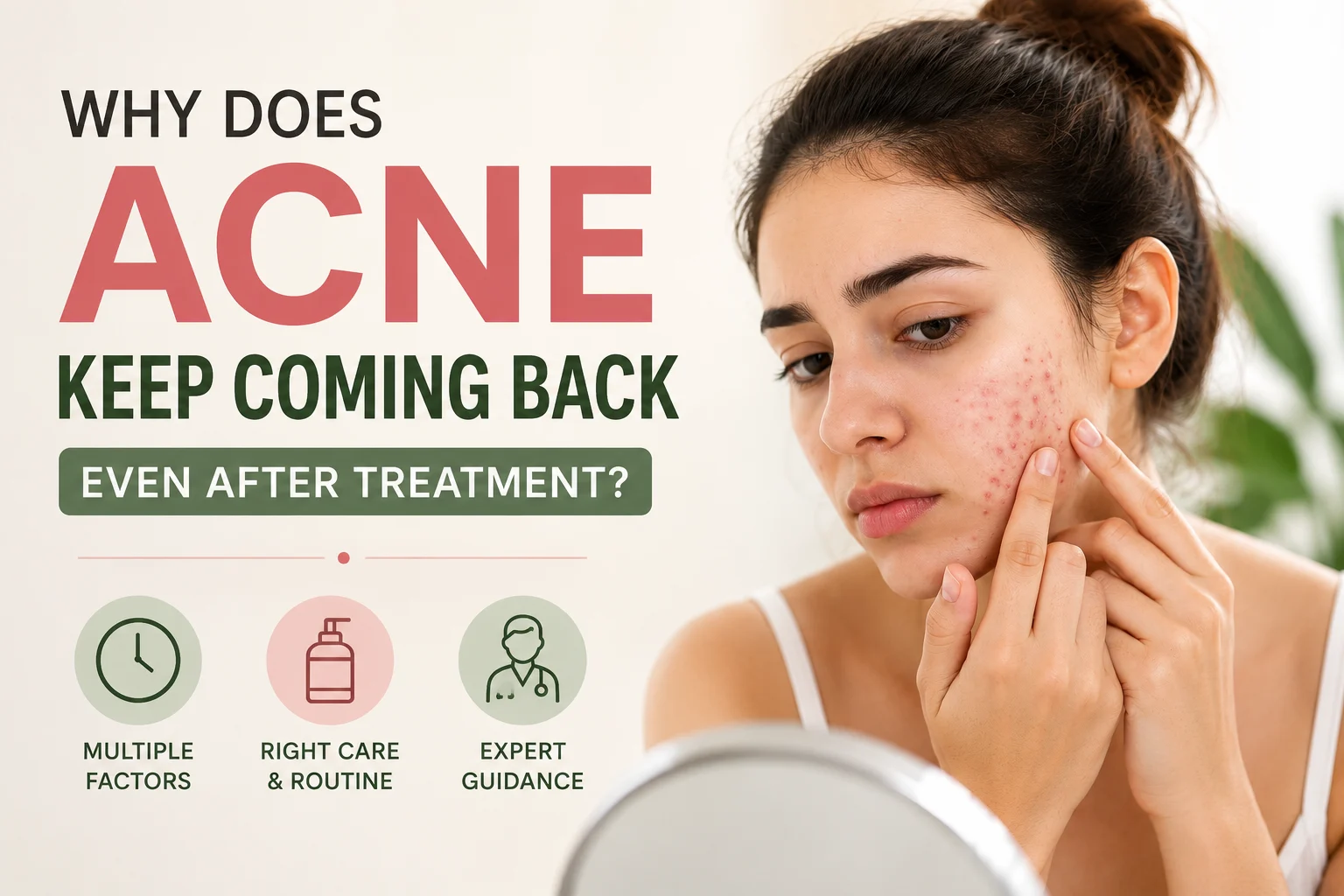
Why Does Acne Keep Coming Back Even After Treatment?

You finally get your acne under control.
The painful pimples settle down. Your skin starts looking clearer, and you no longer worry every time you look in the mirror.
Then, a few weeks or months later, another breakout appears.
Sometimes, it may be just one or two pimples. Other times, acne gradually returns to the same areas, such as the jawline, cheeks, forehead, or chin. You may find yourself reaching for the same products that helped you before and wondering why the problem keeps coming back.
If this sounds familiar, you’re not alone.
Acne can improve with treatment and still return later. This does not necessarily mean that your previous treatment failed. Acne is influenced by several factors, and clearing existing breakouts is often only one part of long-term acne management.
The more important question is:
Why is your acne coming back, and does your treatment approach need to change?
Acne Is More Than Just a Few Pimples
Acne develops through a combination of factors, including clogged pores, excess oil production, inflammation, and changes within the hair follicles.
That is why simply drying out an individual pimple does not always address the underlying problem.
A treatment may improve existing breakouts, but new acne can still develop if the factors contributing to it remain active. This is also why acne treatment often requires patience and consistency.
Improvement may take several weeks, while more noticeable clearing can take longer depending on the type and severity of acne and the treatment being used.
Stopping treatment as soon as your skin looks clear may also increase the likelihood of breakouts returning in some people.
1. You Stopped Treatment as Soon as Your Skin Cleared
This is one of the most common reasons people experience recurring acne.
It can feel natural to stop treatment once there are no visible pimples. However, acne-prone skin may continue to develop new breakouts even after the skin appears clear.
For some people, dermatologists may recommend a maintenance approach after acne has improved. This does not necessarily mean continuing the same treatment at the same strength forever. The approach can be adjusted based on the individual’s skin, acne history, and response to treatment.
It may help to think about acne treatment in two stages:
Getting acne under control
and
Keeping it under control.
These two stages are not always the same.
2. Your Treatment May Have Needed More Time
Acne treatments rarely produce significant results overnight.
It can be tempting to use a product for a week or two, decide that it is not working, and switch to something else.
Then another product gets added.
Then another.
Before long, your routine may include multiple acne treatments, exfoliating acids, scrubs, serums, and active ingredients. Instead of improving your skin, this can sometimes lead to irritation and make it harder to maintain a consistent routine.
Acne treatments generally need time to show results. Rather than constantly switching products, it is often better to use a treatment consistently as advised and review the approach if meaningful improvement does not occur.
If you are unsure whether your treatment is working, speak with a dermatologist rather than continuously adding new products on your own.
3. You’re Treating Only the Pimples You Can See
A visible pimple is often only part of the problem.
If you apply treatment only to individual spots, you may be addressing today’s breakout without helping prevent new lesions from developing in acne-prone areas.
For certain topical acne treatments, dermatologists may recommend applying a thin layer over the affected or acne-prone area as directed rather than using the treatment only as a spot application.
This does not mean using more product than recommended.
It simply means that where and how you apply your treatment can matter.
Always follow the instructions provided for your specific medication or treatment.
4. Hormonal Changes May Be Playing a Role
Some acne follows a noticeable pattern.
For example, some people may notice breakouts appearing or worsening around certain times, such as during the menstrual cycle. Acne around the chin, jawline, and lower face may sometimes follow hormonal patterns, particularly in women.
Acne can also continue or develop during adulthood. Hormonal fluctuations are one possible contributing factor, while stress and certain medications may also influence breakouts in some individuals.
If your acne repeatedly follows a particular pattern, it may be worth discussing this with a dermatologist.
The answer may not always be to keep changing your skincare products.
Sometimes, the underlying trigger needs to be considered.
5. Your Skincare Routine May Be Irritating Your Skin
When acne appears, it is understandable to want to treat it from every possible angle.
You may start using:
- A strong cleanser
- A facial scrub
- Exfoliating acids
- Acne serums
- Spot treatments
- Clay masks
- Retinoids
- Toners
- Multiple face washes
The intention is understandable.
However, more products do not always mean better results.
Over-cleansing, frequent scrubbing, and combining multiple active ingredients can irritate the skin. This irritation may make acne appear worse and can make it difficult to continue treatment consistently.
A simple, gentle skincare routine is often easier to maintain and may work better alongside appropriate acne treatment.
6. You’re Skipping Moisturizer Because Your Skin Is Oily
This is another common mistake.
Having oily skin does not mean your skin does not need moisture.
Some acne treatments can cause dryness, peeling, or irritation. Using a suitable moisturizer may help improve comfort and make it easier to continue treatment consistently.
For acne-prone skin, many people look for moisturizers labelled non-comedogenic, meaning they are formulated not to clog pores.
The goal is not to make oily skin feel heavier.
The goal is to keep the skin comfortable while managing acne.
7. Your Hair and Skincare Products May Be Contributing
Sometimes, the products you use around your face may be contributing to breakouts.
Hair oils, styling products, and certain skincare products can contribute to clogged pores in some people, particularly around the forehead and hairline.
If you repeatedly notice small bumps in these areas, consider what products regularly come into contact with your skin.
Products labelled non-comedogenic, oil-free, or won’t clog pores may be suitable options for some people with acne-prone skin.
However, not every product containing oil will cause acne. Individual skin type and the overall formulation of a product can make a difference.
8. You’re Picking or Squeezing Your Pimples
A tempting pimple can be difficult to leave alone.
However, repeatedly touching, picking, or squeezing acne can increase inflammation and may increase the risk of persistent dark marks or scarring.
Trying to squeeze a painful or deep pimple at home can sometimes make the inflammation worse.
Larger or deeper inflammatory acne lesions may require professional assessment rather than repeated attempts to remove them yourself.
9. Your Acne May Need a Different Treatment Approach
Not every type of acne responds to the same treatment.
Blackheads and whiteheads, inflammatory pimples, and deeper nodules can require different treatment approaches.
Depending on the type and severity of acne, dermatologists may consider options such as topical retinoids, benzoyl peroxide, salicylic acid, azelaic acid, or other topical and systemic treatments.
More severe acne or acne that has not responded adequately to standard treatment may require a different medical approach.
This is one reason copying someone else’s acne routine is not always a good idea.
Their acne may not be the same as yours.
10. It Might Not Actually Be Acne
This is an important point that is sometimes overlooked.
Some skin conditions can look very similar to acne.
Conditions such as folliculitis, rosacea, and perioral dermatitis can cause bumps that may be mistaken for pimples.
If you have been treating what you believe is acne for months without meaningful improvement, it may be worth reconsidering the diagnosis.
A dermatologist can examine the location, appearance, and pattern of the bumps and determine whether you are dealing with acne or another skin condition.
What Should You Do When Acne Keeps Coming Back?
Instead of immediately buying another acne product, take a step back and look at the bigger picture.
Ask yourself:
- When did the breakouts start returning?
- Where are they appearing?
- Did you stop treatment once your skin became clear?
- Do the breakouts follow a particular pattern?
- Have you recently changed your skincare or hair products?
- Are you using several active ingredients at the same time?
- Are you picking or squeezing your pimples?
- Has your acne changed in appearance?
These details can be useful when discussing your skin concerns with a dermatologist.
What Does a Good Long-Term Acne Routine Look Like?
There is no single acne routine that works for everyone. However, many people with acne-prone skin benefit from keeping the basics simple and consistent.
Morning
Gentle cleanser → appropriate treatment if advised → moisturizer → sunscreen
Evening
Gentle cleanser → acne treatment → moisturizer
The exact products and treatment order can vary depending on the medicines and products you are using.
If your dermatologist has provided a specific treatment plan, it is generally better to follow those instructions rather than replacing them with a generic routine found online.
If your treatment causes significant dryness or irritation, do not simply keep adding more products. Speak with your dermatologist so the treatment approach can be reviewed and adjusted if necessary.
When Should You See a Dermatologist for Recurring Acne?
You do not necessarily have to wait until acne becomes severe before seeking professional advice.
Consider consulting a dermatologist if:
- Your acne keeps returning despite consistent treatment
- You have deep or painful pimples
- Acne is leaving scars or persistent dark marks
- Breakouts are becoming more frequent
- Acne suddenly develops during adulthood
- Your breakouts follow a noticeable pattern
- You have tried several products without meaningful improvement
- Your skin is becoming increasingly irritated
- You are unsure whether the bumps are actually acne
Early assessment can help reduce unnecessary trial and error and allow the treatment approach to be tailored to your skin and the type of acne you have.
The Goal Isn’t Just Clear Skin Today
This is perhaps the most important thing to understand about recurring acne.
The goal of acne treatment is not simply to make today’s pimples disappear.
It is also about helping to:
Reduce new breakouts, manage inflammation, lower the risk of scarring, and maintain clearer skin over time.
That often requires patience and consistency.
It may also require changing the treatment approach as your skin and acne patterns change.
What worked for your skin at one stage of life may not always be the right approach years later.
And that is completely normal.
Acne Treatment at Atomic Clinic
If your acne keeps returning despite trying different products, it may be time to stop experimenting and have your skin properly assessed.
At Atomic Clinic, the approach to acne treatment begins with understanding the type, pattern, and severity of acne rather than assuming that every breakout requires the same solution.
A dermatologist can assess factors such as:
- The type and severity of acne
- Previous treatments
- Scarring or pigmentation
- Your current skincare routine
- The pattern of recurring breakouts
Based on this assessment, an appropriate treatment approach can be considered.
The aim is not simply to address the pimples you have today. A proper acne management plan can also focus on controlling recurring breakouts and reducing the risk of long-term marks and scars.
If you are looking for acne treatment in Varanasi, a professional skin assessment can be a helpful first step when recurring breakouts are becoming difficult to manage.
Frequently Asked Questions
Why does my acne come back after treatment?
Acne can return because the tendency to develop clogged pores and inflammation may continue even after the skin has cleared. Hormonal changes, skincare habits, treatment consistency, and the need for a maintenance approach may also play a role.
Does acne treatment need to continue after my skin clears?
For some people, yes. A dermatologist may recommend a maintenance approach after acne improves to help reduce the risk of new breakouts. The type and frequency of treatment can differ from the initial acne-control phase.
Why do I still get acne even though I wash my face regularly?
Acne is not simply caused by having a dirty face. Over-washing and scrubbing can irritate the skin. Acne develops through several factors, including clogged pores, oil production, and inflammation.
Can stress make acne worse?
Some people notice acne flare-ups during stressful periods. If you consistently notice a relationship between stress and your breakouts, mention this pattern during a dermatology consultation.
Why does my acne keep appearing on my jawline?
Jawline acne can have several possible causes. In some women, acne around the lower face and jawline may follow hormonal patterns. However, the location of acne alone is not enough to determine its cause.
Should I change my acne treatment if it isn’t working?
Avoid switching products every few days. Acne treatments can take time to show improvement. If you have been using a treatment consistently without meaningful results, speak with a dermatologist about whether the diagnosis or treatment approach needs to be reassessed.
Can recurring acne cause permanent scars?
Inflammatory and deeper acne can increase the risk of scarring, particularly when pimples are repeatedly picked or squeezed. Early and appropriate management may help reduce this risk.
Final Thoughts
If your acne keeps coming back, do not automatically assume that you are doing something wrong.
Sometimes, a treatment was not given enough time to work. Sometimes, the skin may need a maintenance approach. In other cases, hormones, irritating skincare products, or other contributing factors may be involved.
And sometimes, what appears to be acne may actually be a different skin condition.
Instead of continuously adding another serum, cream, or spot treatment, take a step back and look at the bigger picture.
Recurring acne deserves proper assessment and a long-term management plan, not endless trial and error.
If breakouts continue despite consistent care, a dermatologist can help identify possible contributing factors and recommend an approach appropriate for your individual skin concerns.
Medical Disclaimer: This article is intended for general educational purposes only and does not replace an individual consultation with a dermatologist or another qualified healthcare professional. Acne treatment should be selected based on individual factors, including skin type, acne severity, medical history, and other relevant considerations. If you have severe, painful, persistent, or scarring acne, seek professional medical advice.