The Benefits of Hyaluronic Acid for Your Skin

If you’ve spent any time looking at skincare products, you’ve probably noticed how often hyaluronic acid appears on the label.
It’s in serums, moisturisers, face masks, gels and even some products made for oily or acne-prone skin.
That can make it seem as though hyaluronic acid is one of those ingredients you simply have to have.
It isn’t.
But there is a good reason dermatologists and skincare formulators use it so often.
Hyaluronic acid is very good at helping the skin hold onto water. When your skin is lacking hydration, this can make a noticeable difference to how it feels and, to some extent, how it looks.
The confusion usually starts when marketing takes that simple benefit and turns it into much bigger promises.
So let’s separate the useful part from the hype.
First, what is hyaluronic acid?
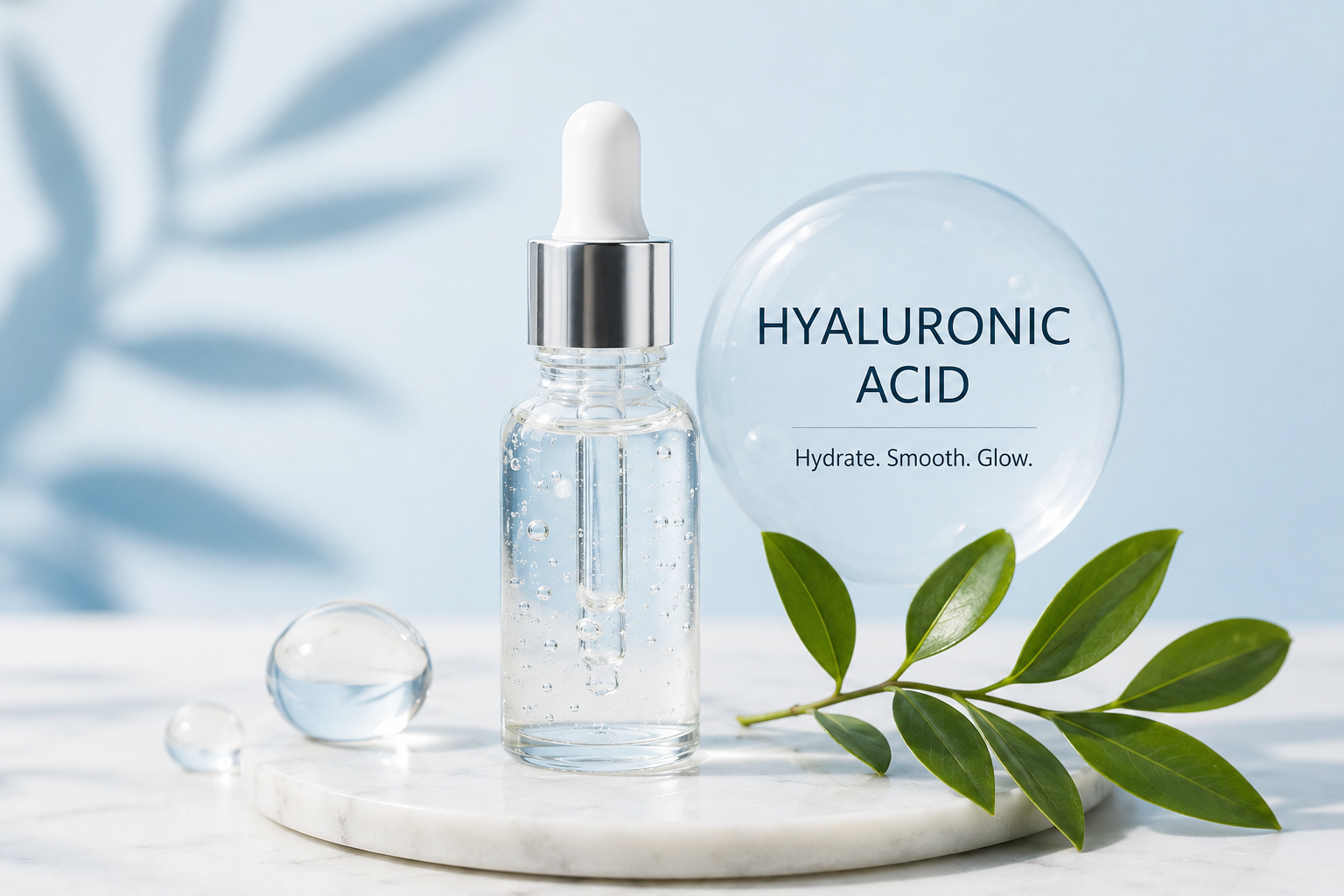
Hyaluronic acid, also called hyaluronan, is a substance naturally found in the human body. A significant amount is present in the skin, where it contributes to the skin’s ability to retain water and maintain its structure.
In a skincare product, its main role is as a humectant.
In simple terms, a humectant helps attract and hold water.
That’s different from an exfoliating acid such as glycolic acid or salicylic acid. Hyaluronic acid isn’t there to dissolve dead skin cells.
So despite having the word “acid” in its name, it doesn’t behave like the acids people usually associate with chemical exfoliation.
What can you actually expect from it?
Imagine your skin after a long day when you’ve been travelling, sitting in air conditioning or spending time in a dry environment.
Sometimes the first thing you notice isn’t a visible skin problem. It’s the feeling.
Your face feels tight after washing. The skin around your cheeks feels uncomfortable. Fine lines suddenly seem more obvious when you look closely in the mirror.
Hydration can make a difference here.
Topical hyaluronic acid has been studied for its ability to increase skin hydration, and clinical research has reported improvements in hydration and skin appearance with topical formulations.
That doesn’t mean the ingredient is transforming your skin overnight.
It means that when the outer layers of the skin have better hydration, they can feel more comfortable and look smoother.
And honestly, that’s where I think hyaluronic acid makes the most sense.
Hydration isn’t the same as moisturising
This is a small distinction, but it helps explain why some people use a hyaluronic acid serum and still feel dry.
Hydration refers to the amount of water in the skin.
Dryness can involve a lack of oils and lipids that help maintain the skin barrier and reduce water loss.
These aren’t identical problems.
A hyaluronic acid serum can help with hydration, but your skin may still need a moisturiser afterwards.
Think of it this way: adding water and preventing excessive water loss are related jobs, but they aren’t exactly the same job.
That is why a routine containing both a hydrating ingredient and a suitable moisturiser often makes more sense than relying on a serum alone.
Can oily skin be dehydrated?
Yes, and this surprises a lot of people.
Oil and water aren’t the same thing.
Someone can have an oily forehead, a shiny nose and still experience tightness or dehydration elsewhere on the face.
I’ve also seen people with oily skin become overly aggressive with cleansing because they’re trying to get rid of every trace of oil. Strong cleansers, frequent washing and too much exfoliation can leave the skin feeling uncomfortable without actually solving the underlying problem.
For oily skin, the better approach is usually not to avoid hydration altogether.
Instead, look for a lighter formulation—a gel or lightweight serum, for example—and avoid products that feel unnecessarily heavy for your skin.
What about dry skin?
Dry skin can benefit from hyaluronic acid, but don’t expect one serum to do the whole job.
If your skin is genuinely dry, especially during colder or drier weather, you may need a moisturiser containing ingredients that help soften the skin and reduce water loss.
A basic routine could be as simple as:
Morning:
Cleanser → Hydrating serum → Moisturiser → Sunscreen
Night:
Cleanser → Hydrating serum → Moisturiser
There is no need to keep adding products just because your skin feels dry.
Sometimes the better move is actually to remove something.
For example, if your face feels tight immediately after cleansing, changing the cleanser may help more than purchasing another serum.
Does hyaluronic acid get rid of wrinkles?
No.
This is one of the claims I’d be careful about.
Hyaluronic acid can improve hydration, and better-hydrated skin may look temporarily plumper and smoother. This can make very fine dehydration lines less noticeable.
But that isn’t the same thing as removing a wrinkle.
Age-related wrinkles develop through several processes, including changes in collagen, elastin, skin structure and cumulative sun exposure.
A hydrating serum can’t reverse all of that.
If your concern is premature ageing, daily sunscreen is considerably more important than whether your serum contains 1%, 2% or some other advertised concentration of hyaluronic acid.
Hyaluronic acid can have a place in an anti-ageing routine. It just shouldn’t be mistaken for the entire routine.
Does a higher percentage mean a better product?
Not necessarily.
This is where skincare marketing can be misleading.
A bigger number on the front of a bottle is easy to understand, so we naturally assume that a higher percentage must produce a stronger result.
Skin doesn’t work quite that neatly.
The formulation matters. The form of hyaluronic acid matters. The other ingredients matter. The texture matters. And, most importantly, whether the product suits your skin matters.
There are also different molecular sizes of hyaluronic acid used in cosmetic formulations, which can behave differently when applied to the skin.
So I wouldn’t choose a product simply because it has the highest percentage you can find.
Why do some products mention different molecular weights?
If you’ve ever read a hyaluronic acid label closely, you may have come across phrases such as “low molecular weight,” “high molecular weight” or “multi-molecular hyaluronic acid.”
These terms describe the size of the molecules.
Larger and smaller forms can behave differently in a formulation and interact with the skin differently. That’s one reason manufacturers sometimes combine several forms.
It sounds very technical, but you don’t need to become an expert in molecular weight to choose a good skincare product.
A well-designed formulation is more important than chasing a particular phrase on the packaging.
Should you put hyaluronic acid on wet skin?
You don’t need to soak your face.
Many people find it convenient to apply a hydrating serum to slightly damp skin after cleansing and then follow with moisturiser.
The important part is what comes next.
If your skin is dry or dehydrated, don’t stop at the serum simply because the serum contains hyaluronic acid.
Apply your moisturiser afterwards.
And during the daytime, sunscreen remains essential.
A simple routine is often enough:
Cleanse → Hydrate → Moisturise → Protect
You don’t need a complicated ritual for your skin to be healthy.
Can you use hyaluronic acid every day?
For most people, yes.
It is commonly used once or twice a day, depending on the particular product and the rest of the routine.
Because it is mainly being used for hydration, it can fit into both morning and evening skincare.
That said, every skin is different.
If a product containing hyaluronic acid makes your skin sting, burn or become red, don’t assume that you need to “push through” the reaction. Look at the complete ingredient list. The problem may be another component of the product rather than hyaluronic acid itself.
Is it safe for sensitive skin?
Hyaluronic acid is generally well tolerated, but sensitive skin requires a little more thought than simply checking whether one ingredient is considered gentle.
A serum can contain fragrance, preservatives, botanical extracts, acids or other active ingredients alongside hyaluronic acid.
If your skin reacts easily, introduce one new product at a time.
That’s practical advice for any new skincare product because it gives you a better chance of identifying what caused a reaction.
If your skin is already irritated, I would also avoid changing five things at once.
A simple routine is much easier to troubleshoot.
Can you use hyaluronic acid with retinol?
Generally, yes.
In fact, hydration can be particularly useful when someone is starting a retinoid and experiencing some dryness.
For example, someone might use their retinoid at night and keep the rest of the routine relatively simple: cleanser, hydrating product and moisturiser.
But there’s a limit.
If your skin is severely irritated, burning or peeling, adding more products isn’t necessarily the solution. The retinoid frequency or the rest of the routine may need to be adjusted.
If the irritation is significant or persistent, speak with your dermatologist rather than trying to cover it up with another serum.
What about Vitamin C?
Hyaluronic acid and Vitamin C can generally be used together.
There isn’t a rule saying you have to keep them several hours apart simply because they’re both skincare ingredients.
A morning routine might include Vitamin C followed by a hydrating product, moisturiser and sunscreen.
But again, don’t mistake a longer routine for a better routine.
If your skin is happy with three or four products, there’s no reason to turn it into eight.
Can hyaluronic acid repair a damaged skin barrier?
I’d be careful with that wording.
Hyaluronic acid can support hydration, which is useful when the skin is dry or uncomfortable. But skin-barrier health is more complicated than simply adding one hydrating ingredient.
The barrier helps control water loss and protects the skin from environmental irritants. Lipids, including ceramides, play an important role in its structure.
That’s why products aimed at dry or sensitive skin often combine humectants with moisturising and barrier-supporting ingredients.
The takeaway is fairly simple:
Don’t expect one ingredient to solve every skin problem.
Good skincare is usually about how the whole routine works together.
Why does my skin still feel dry after using hyaluronic acid?
This is worth investigating instead of immediately buying a stronger serum.
Start with the basics.
Look at your cleanser.
Look at how often you’re exfoliating.
Look at whether you’re using several active ingredients together.
Look at your moisturiser.
And think about what has changed recently.
Maybe you’ve started using a retinoid. Maybe you’ve been washing your face more often. Maybe the weather has become drier. Maybe you’ve been using an acne treatment that is drying your skin.
All of those details matter.
If your skin feels tight every time you wash your face, for instance, the cleanser may deserve more attention than the serum.
Skincare isn’t always about adding something.
Sometimes the most useful change is removing the thing that’s causing the problem.
Can hyaluronic acid cause dryness?
People sometimes describe their skin as feeling drier after using a hyaluronic acid product and assume that the ingredient itself must be drying.
The situation isn’t always that straightforward.
The complete formulation, the surrounding skincare routine and the environment can all affect how the skin feels.
If a particular product consistently causes discomfort, stop using it and reassess the formula rather than assuming you need more of it.
And if your skin is persistently dry, itchy or irritated, don’t keep experimenting indefinitely.
There may be an underlying skin condition that needs proper assessment.
When dryness isn’t really just dryness
This is probably the part of skincare advice that gets overlooked most often.
Not every dry-looking face simply needs a better moisturiser.
Persistent itching, redness, burning, cracking, scaling or inflammation can occur with conditions such as eczema, contact dermatitis and rosacea, among others.
If you’ve simplified your routine and your skin still isn’t settling, it’s worth getting an appropriate diagnosis.
A dermatologist can look at the pattern of symptoms and decide whether you’re dealing with ordinary dryness, irritation from products or something that needs specific treatment.
Buying another serum without knowing the cause can waste both time and money.
So, who should use hyaluronic acid?
There isn’t one skin type that “needs” hyaluronic acid.
It can be useful if your skin feels dehydrated, tight or uncomfortable, and it can be included in routines for dry, combination and oily skin.
The formulation should match the skin.
For oily skin, a lightweight gel or serum may feel better.
For dry skin, hyaluronic acid may work better as one part of a richer moisturising routine.
For sensitive skin, the entire ingredient list deserves attention.
And for ageing skin, remember that hydration is only one piece of the picture. Sun protection remains fundamental.
The simple way to think about hyaluronic acid
If you remember only one thing, remember this:
Hyaluronic acid is mainly a hydration ingredient.
It isn’t an exfoliating acid.
It isn’t an acne treatment.
It doesn’t erase wrinkles.
And it doesn’t replace sunscreen.
What it can do is help increase hydration and make the skin feel more comfortable and look smoother. Research on topical hyaluronic acid supports its role as a hydrating skincare ingredient, with clinical studies showing measurable improvements in skin hydration and some aspects of skin appearance.
That’s already a useful job.
You don’t need to make it sound more impressive than it is.
The best skincare routine is rarely the one with the most products. It’s the one that addresses the actual problem without creating new ones.
Frequently Asked Questions
Can I use hyaluronic acid every day?
Yes. Most people can use a topical hyaluronic acid product daily. Follow the directions for the particular product you’re using.
Is hyaluronic acid good for dry skin?
It can help with hydration, but dry skin may also need a moisturiser that helps reduce water loss and improve comfort.
Is hyaluronic acid suitable for oily skin?
Yes. Oily skin can still be dehydrated. A lightweight serum or gel can provide hydration without necessarily feeling heavy.
Should I apply hyaluronic acid to damp skin?
Applying it to slightly damp skin is a common approach. Your face doesn’t need to be soaking wet.
Do I need moisturiser after hyaluronic acid?
Often, yes—particularly if your skin is dry or dehydrated. A moisturiser can help maintain comfort and reduce water loss.
Can I use hyaluronic acid with retinol?
Generally, yes. The combination is commonly used, particularly when hydration is needed alongside a retinoid routine.
Can I use hyaluronic acid with Vitamin C?
Yes. They can generally be used together in the same routine.
Does hyaluronic acid remove wrinkles?
No. It doesn’t remove wrinkles. Better hydration may temporarily make some fine dehydration lines look less noticeable.
Is a higher percentage of hyaluronic acid better?
Not automatically. The complete formulation matters more than simply choosing the product with the biggest percentage.
Can hyaluronic acid replace moisturiser?
Not necessarily. Hyaluronic acid mainly helps with hydration, while moisturisers contain ingredients that can help soften the skin and reduce water loss.
How quickly does hyaluronic acid work?
Hydration-related changes can be noticeable relatively quickly, particularly in how the skin feels. The visible result varies with the formulation and the condition of your skin.
When should I see a dermatologist about dry skin?
If dryness is persistent or accompanied by itching, burning, redness, cracking, significant peeling or inflammation, it’s worth getting the cause assessed rather than continually changing skincare products.